Linux Distributions
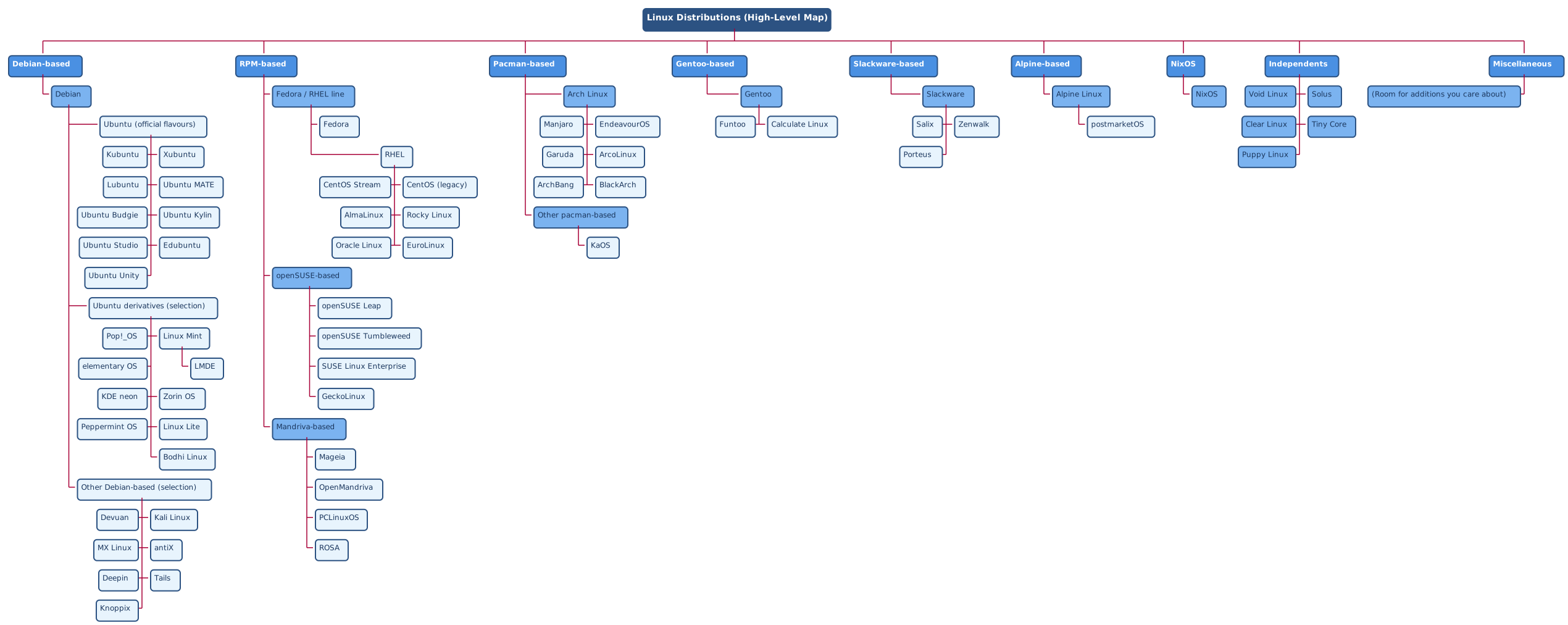
Quick Start Guide
This guide provides a comprehensive overview of Linux distributions, from beginner-friendly summaries to technical deep dives. Whether you're choosing your first Linux distro or need detailed technical specifications, this document covers the major distribution families, their characteristics, and use cases.
The Three Main Families
Debian/Ubuntu - Stability & ease of use
- Ubuntu: Most popular desktop Linux
- Debian: Rock-solid server choice
- Linux Mint: Best for Windows switchers
- Package:
apt install package
Red Hat/Fedora - Enterprise & cutting-edge
- Fedora: Latest stable features
- RHEL/AlmaLinux: Enterprise with 10-year support
- openSUSE: Great admin tools
- Package:
dnf install package
Arch - DIY & bleeding-edge
- Arch: Build from scratch, always latest
- Manjaro: Arch made easy
- EndeavourOS: Near-vanilla Arch
- Package:
pacman -S package
Which One for You?
| Your Need | Best Choice | Why |
|---|---|---|
| Just starting | Ubuntu LTS or Linux Mint | Works out of box, huge community |
| Learning for career | Fedora or Ubuntu | Industry standards |
| Old/weak hardware | MX Linux or antiX | Lightweight, runs on anything |
| Servers/enterprise | RHEL/AlmaLinux or Debian | Long-term stability |
| Latest software | Arch or Fedora | Cutting-edge packages |
| Privacy focused | Tails or Whonix | Built for anonymity |
Key Terms
- Package Manager: How you install software (like app stores)
- LTS: Long Term Support - stable for years
- Rolling Release: Always up-to-date, no version numbers
- Desktop Environment: The GUI (GNOME, KDE, XFCE, etc.)
Technical Deep Dive
For those seeking deeper technical understanding, the following sections provide comprehensive details about each distribution family, their architectures, and specialized use cases.
The Linux ecosystem comprises hundreds of distributions, each evolved from different philosophical approaches, technical requirements, and user communities.
Major Distribution Families
Traditional Desktop & Server Distributions
Debian-based Distributions
The Debian family represents one of the largest ecosystems in Linux, characterized by the APT (Advanced Package Tool) package management system and .deb package format1.
Core Distribution: Debian
- Release cycle: Stable (2-3 years), Testing, Unstable (Sid)
- Package management: APT/dpkg
- Philosophy: Free software guidelines (DFSG)
- Init system: systemd (default), but derivatives like Devuan, MX Linux, and antiX use alternatives (sysvinit, runit)
Ubuntu and Derivatives Ubuntu, founded by Canonical Ltd. in 2004, provides regular 6-month releases and LTS (Long-Term Support) versions every 2 years2. Official flavours include:
- Kubuntu (KDE Plasma)
- Xubuntu (Xfce)
- Lubuntu (LXQt)
- Ubuntu MATE, Budgie, Kylin, Studio, Edubuntu, Unity
Notable Ubuntu derivatives:
- Pop!_OS: System76's distribution optimized for their hardware
- Linux Mint: User-friendly with Cinnamon desktop
- elementary OS: macOS-inspired design philosophy
- Zorin OS: Windows-like transition distribution
Other Debian-based:
- Devuan: Debian fork using sysvinit/OpenRC instead of systemd
- Kali Linux: Penetration testing and security auditing toolkit
- MX Linux: Midweight distribution with sysvinit, antiX components
- antiX: Lightweight, systemd-free with runit/sysvinit
- Tails: The Amnesic Incognito Live System for privacy
- Deepin: Chinese distribution with custom DDE (Deepin Desktop Environment)
- Parrot OS: Security, privacy, and development platform
RPM-based Distributions
RPM (Red Hat Package Manager) distributions use the .rpm format and various package management frontends3.
Fedora/RHEL Line
- Fedora: Red Hat's community distribution, ~6-month release cycle
- Package management: DNF (replaced YUM in Fedora 22)
- Editions: Workstation, Server, IoT, Silverblue (immutable desktop)
- RHEL: Enterprise distribution with 10-year support lifecycle
- Package management: YUM (RHEL 7), DNF (RHEL 8+)
- CentOS Stream: Upstream development platform for RHEL
- AlmaLinux/Rocky Linux: Community RHEL rebuilds post-CentOS changes
- Oracle Linux: Oracle's RHEL-compatible distribution with UEK kernel option
openSUSE Family
- openSUSE Leap: Regular release (annual) with SUSE Linux Enterprise base
- openSUSE Tumbleweed: Rolling release with automated testing
- SUSE Linux Enterprise: Commercial enterprise distribution
- GeckoLinux: openSUSE spin with out-of-box usability focus
- Package management: Zypper (CLI), YaST (GUI configuration)
- Unique feature: Btrfs with snapshots by default, rollback capability
Mandriva Derivatives
- Mageia: Community-driven Mandriva fork
- OpenMandriva: Another Mandriva continuation
- PCLinuxOS: Rolling release Mandriva derivative
Enthusiast & DIY Distributions
Pacman-based Distributions
Primarily Arch Linux and derivatives, using the pacman package manager and .pkg.tar.zst package format4.
Arch Linux
- Philosophy: KISS (Keep It Simple, Stupid)
- Rolling release model
- Package format: .pkg.tar.zst (since 2019, previously .pkg.tar.xz)
- AUR (Arch User Repository) for community packages
Arch Derivatives:
- Manjaro: User-friendly Arch with 1-2 week package delay for stability testing
- Own package repositories, hardware detection (mhwd)
- EndeavourOS: Near-vanilla Arch experience with Calamares installer
- Direct Arch repositories, minimal modifications
- Garuda: Gaming and performance focused with BTRFS snapshots
- ArcoLinux: Educational distribution with learning phases
- BlackArch: Security and penetration testing (2800+ tools)
Source-based Distributions
Gentoo
- Portage package management with emerge
- Compile-time optimization through USE flags
- Choice of init: OpenRC (default), systemd, runit
- Profiles: desktop, server, hardened, no-multilib
- Derivatives:
- Funtoo: Daniel Robbins' fork with git-based portage tree
- Calculate Linux: Binary packages available, Russian origin
- Sabayon: User-friendly with binary packages (discontinued)5
Minimalist & Specialized Distributions
Slackware Family
Slackware
- Oldest actively maintained distribution (1993)
- Philosophy: Simplicity, stability, minimal modification of upstream
- Package management: pkgtools (no dependency resolution)
- Init system: SysV init (BSD-style)
- Release cycle: Irregular (can be 2-5+ years between releases)
- Third-party tools: sbopkg, slapt-get for dependency handling
- Derivatives:
- Salix: One app per task, dependency resolution
- Zenwalk: Desktop-focused, optimized for speed
- Porteus: Modular live system, less than 300MB
Alpine Linux
- musl libc instead of glibc (smaller, stricter POSIX)
- OpenRC init system (default), s6 available
- Minimal base system (~5 MB)
- Package management: apk (Alpine Package Keeper)
- Security: Position Independent Executables (PIE), stack smashing protection
- Primary use: containers (Docker official images), embedded systems, routers
- Derivatives: postmarketOS (mobile devices)6
NixOS
- Declarative configuration model (configuration.nix)
- Functional package management with Nix language
- Reproducible system configurations across machines
- Atomic upgrades and rollbacks (generations)
- Nix store: immutable package storage (/nix/store/)
- Flakes: experimental reproducible project definitions
- Use cases: DevOps, development environments, research7
Independent Distributions
Notable Independent Projects:
- Void Linux: runit init, xbps package manager, musl/glibc variants
- Rolling release, BSD-influenced design
- Solus: eopkg package manager, Budgie desktop creator
- Curated rolling release, desktop-focused
- Clear Linux: Intel's aggressively performance-optimized distribution
- Autovectorization, function multi-versioning, aggressive compiler flags
- Stateless design, swupd updates, telemetry-driven optimizations
- Tiny Core Linux: Minimal (~11 MB) modular distribution
- RAM-based operation, extension system
Security & Privacy Distributions
Note: Security-focused distributions exist across multiple families - Kali (Debian), BlackArch (Arch), Parrot (Debian), etc.
Standalone Security Systems:
- Qubes OS: Xen-based compartmentalization, security through isolation
- Whonix: Anonymity-focused, Tor-based, runs in VMs
- Kodachi: Routes all traffic through VPN + Tor
Container & Cloud-Native Distributions
Container-Optimized Systems:
- Fedora CoreOS: Immutable, auto-updating container host (successor to Container Linux)
- Flatcar Linux: Container Linux fork, drop-in replacement
- Bottlerocket: AWS container-optimized OS, minimal attack surface
- RancherOS: Minimal Linux, Docker as PID 1 (discontinued 2020)
- Alpine Linux: De facto standard for container base images
Technical Comparison
| Family | Package Format | Package Manager | Init System | Release Model | Notes |
|---|---|---|---|---|---|
| Debian | .deb | APT/dpkg | systemd* | Stable: Fixed (2-3yr), Testing: Semi-rolling, Unstable: Rolling | *Devuan, MX, antiX use sysvinit/runit |
| Fedora/RHEL | .rpm | DNF (YUM legacy) | systemd | Fedora: Fixed (6mo), RHEL: Fixed (10yr) | DNF replaced YUM in Fedora 22 |
| openSUSE | .rpm | Zypper/YaST | systemd | Leap: Fixed (annual), Tumbleweed: Rolling | Btrfs snapshots default |
| Arch | .pkg.tar.zst | pacman | systemd | Rolling | AUR for community packages |
| Gentoo | source/ebuild | Portage | OpenRC/systemd | Rolling | USE flags for compilation |
| Slackware | .tgz/.txz | pkgtools | SysV | Irregular (2-5+ yr) | No dependency resolution |
| Alpine | .apk | apk | OpenRC | Fixed (6mo) | musl libc, ~5MB base |
| NixOS | derivations | Nix | systemd | Rolling | Declarative configuration |
Selection Criteria
When choosing a distribution family, consider:
- Support lifecycle: Enterprise (RHEL 10yr, SLES 13yr) vs. community (varied)
- Package availability: Repository size and third-party support
- Debian/Ubuntu: Largest repositories (>60,000 packages)
- AUR: Community packages for Arch
- Flatpak/Snap: Distribution-agnostic options
- System resources:
- Minimal: Alpine (~5MB), Tiny Core (~11MB), antiX (700MB RAM minimum)
- Midweight: MX Linux, Xubuntu (1GB RAM)
- Full-featured: Ubuntu, Fedora (2-4GB RAM recommended)
- Update philosophy:
- Rolling: Always current (Arch, Tumbleweed, Gentoo)
- Fixed: Predictable, stable (Debian Stable, RHEL, Ubuntu LTS)
- Semi-rolling: Balance (Debian Testing, Fedora)
- Init system:
- systemd: Fedora, Arch, Ubuntu, Debian (default)
- OpenRC: Gentoo (default), Alpine, Artix
- runit: Void, Artix option
- SysV: Slackware, Devuan
- Community size:
- Large: Ubuntu, Debian, Arch (extensive wikis/forums)
- Enterprise: RHEL, SUSE (paid support available)
- Niche but dedicated: Gentoo, Slackware, Void
- Small: Solus, Clear Linux (limited third-party support)
- Documentation quality:
- Arch Wiki: Comprehensive, useful for all distros
- Gentoo Handbook: Detailed, educational
- Ubuntu: Extensive community documentation
- RHEL: Professional enterprise documentation